
Sorter
What Is It Made Of?
A tactile wooden set that demonstrates how things are made. Children arrange the illustrated steps on a round board, exploring the sequence of processes and cause-and-effect relationships, while also developing attention and speech. The large, smooth pieces are easy to hold and fun to rearrange, and different processes can be explored and compared. Ideal for home or classroom use, for individual play or in small groups.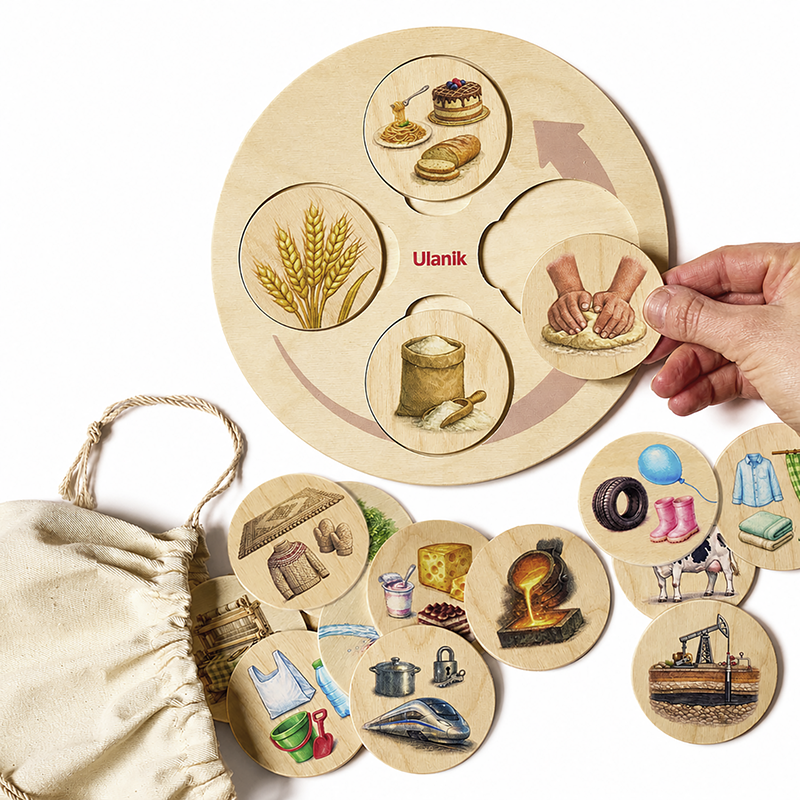
Contents:
- round base
- 48 chips
- linen bag for storing chips
- instruction leaflet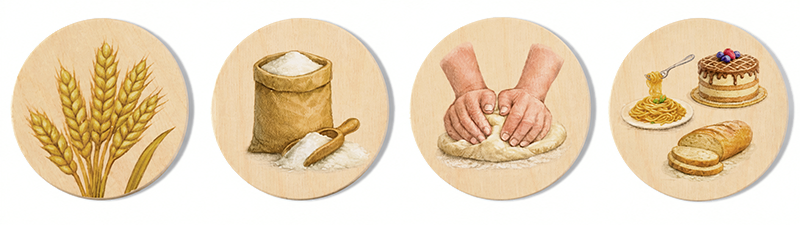
Wheat - flour - dough - bread, spaghetti, cake
Wheat. Wheat is a plant. It grows in fields. It has long stems and ears, and inside the ears there are tiny grains. When the wheat ripens, it is harvested by special machines called combine harvesters.
Flour. Flour is made from wheat grains. The grains are cleaned and then ground — almost like rubbing them into a very fine powder. Flour is soft, light-coloured and loose.
Dough. Water or milk is added to flour. Sometimes eggs, butter, salt or sugar are added too. Then everything is mixed well and kneaded by hand until the dough becomes soft and smooth.
Different foods can be made from dough.
To make bread, the dough is shaped by hand or placed in a special baking tin. The dough needs some time to rise — to become bigger in size — and then it is baked in a hot oven. The bread becomes golden-brown, soft inside and crusty outside.
To make spaghetti, the dough is rolled out into a thin layer, cut into long strips and dried. Later, this dry spaghetti can be boiled in water, and it becomes soft again.
To make a cake, sweet dough is prepared. Cake layers are baked from it. The layers are spread with cream and decorated on top — and that is how a cake is made.
Ore - molten metal - metal sheets - pot, lock, train
Ore is mined in mountains or deep underground. At first, ore looks like ordinary heavy stones, but inside there are useful particles of metal.
Molten Metal. To get metal, ore is heated very strongly in a large furnace. Because of the heat, the metal melts and becomes liquid, like a very hot fiery river. Then the liquid metal is carefully poured into special moulds.
Metal Sheets. When the metal in the mould cools down, it becomes solid again. Different blanks are made from it: plates, sheets, rods and parts. Metal sheets are strong, smooth and shiny. They can be cut, bent and joined with other parts.
Different objects can be made from metal, for example, a pot, a lock and a train.
To make a pot, a metal sheet is bent and shaped into a cylinder. Then the bottom, handles and lid are attached to the pot. Metal is good for making pots because it is strong and can be heated on a stove.
To make a lock, small strong parts are cut out of metal and then joined together. Тhe lock is a special mechanism: when the right key is inserted, the parts move, and the lock can open and close. A lock helps to close doors, cupboards or suitcases.
To make a train, many metal parts are needed. Metal is used to make the body, wheels, rails, fastenings and different parts inside the train. Metal is strong, so a train can be big and heavy and can carry many people or goods.
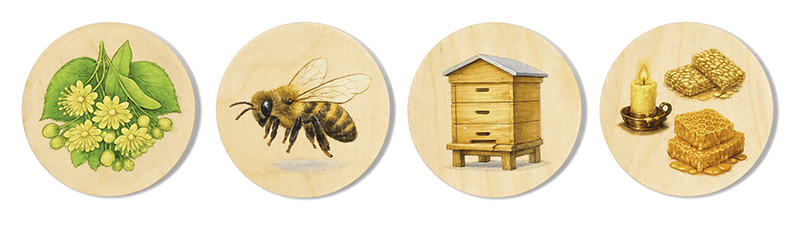
Linden Flowers - Bee - Beehive - Honey, Kozinaki, Beeswax Candle
Linden Flowers. A linden is a tree. In summer, small fragrant flowers bloom on it. They smell sweet and attract bees. Inside the flowers there is sweet juice called nectar.
A bee is a small, hardworking insect. It flies from flower to flower and collects nectar with its proboscis, like with a tiny tube. Bees carry pollen on their legs and help plants grow and produce fruit.
A beehive is a house for bees. A big bee family lives inside: the bees work together, build honeycombs and store flower nectar in them. They make honeycombs from wax — a special substance that bees produce themselves.
From what bees make, we can get different useful and tasty things: honey, kozinaki and a beeswax candle.
To make honey, a bee collects sweet nectar from linden flowers and brings it to the beehive. There, the bees pass the nectar to one another and put it into the honeycombs. The extra water slowly evaporates, and the nectar becomes thick, sweet honey.
To make kozinaki, honey is heated and mixed with nuts, seeds or grains. Then the sweet mixture is spread out in an even layer and left to harden. When it becomes firm, it is cut into pieces — and sweet, crunchy kozinaki are ready.
To make a candle, beeswax is used. The wax is carefully melted, a little string — called a wick — is placed inside, and the wax is poured into a mould. When the wax cools down and becomes solid, it turns into a candle. If you light the wick, the candle will shine with a soft, warm flame.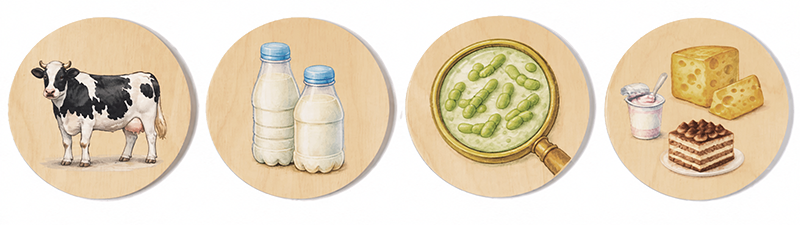
Cow - Milk - Lactic Acid Bacteria - Cheese, Yogurt, Tiramisu
A cow is a farm animal. It lives on a farm, eats grass and hay, drinks water and gives milk. People take care of the cow: they feed it, clean its stall and milk it with a special machine or by hand.
Milk is white, liquid and nutritious. Fresh milk is first checked, cleaned and often heated to make it safe. Many different foods can be made from it.
Lactic Acid Bacteria are tiny living helpers. You cannot see them with your eyes, but they can change milk: they make it thicker and give it a special taste.
Different foods can be made from milk: cheese, yogurt and tiramisu.
To make cheese, special substances and helpful bacteria are added to milk. The milk thickens and separates into soft curds and liquid. The curds are collected, pressed, placed into a mould and left to mature. Over time, the cheese becomes firm, fragrant and tasty.
To make yogurt, lactic acid bacteria are added to warm milk. Then the milk is left in a warm place for several hours. The bacteria work, and the milk becomes thick, smooth and a little tangy. Berries, fruit or a little sugar can be added to yogurt.
To make tiramisu, dairy products are used, such as soft creamy mascarpone cheese or cream. The cheese is mixed with cream or eggs to make a delicate cream. Then the cream is layered with soft biscuits and sprinkled with cocoa on top. That is how milk and dairy products can become a delicious dessert.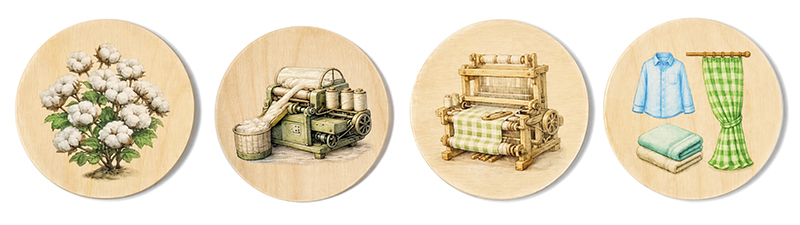
Cotton - Twisting threads - Fabric - Shirt, Towel, Curtains
Cotton is a plant. Its seed pods are soft white look like little fluffy clouds. Inside this fluff there are thin fibres, which are later used to make thread and fabric.
Twisting threads. When the cotton bolls ripen, they are picked from the plant. Then the fluffy fibres are cleaned: seeds, dry leaves and extra bits of dirt are removed. Clean cotton is soft, light and fluffy. Then, on a special machine, its fibers are stretched and twisted into long, strong threads.
Fabric. Thin threads are made from cotton fibres, and fabric is woven from these threads. To do this, the threads are stretched on a loom and woven together: one thread goes lengthwise, another goes across. Little by little, cotton fabric is made — soft, strong and pleasant to touch.
Different things can be made from cotton fabric: clothing, towels and curtains.
To make a shirt, the fabric is first cut into pieces of the right shape: the back, the front, the sleeves and the collar. Then these pieces are sewn together with thread, buttons are added, and it becomes clothing that can be worn.
To make a towel, soft cotton fabric is used because it absorbs water well. The edges of the fabric are neatly hemmed so they do not fray. A towel can be used to dry your hands, face or body after washing or bathing.
To make curtains, cotton fabric is measured to fit the window. Then the edges are hemmed, and loops are sewn onto the top. Curtains are hung on the window: they decorate the room and help block bright sunlight.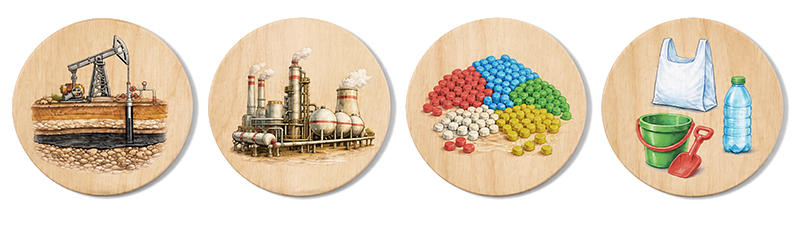
Oil - Factory - Plastic Granules - Plastic bag, Bucket and a shovel, Bottle
Oil is a thick, dark liquid that is found deep underground. To get it, people drill wells and bring the oil up to the surface using special machines. Oil is used to make fuel, as well as different materials, such as plastic.
Factory. The oil is taken to a large factory. There it is heated, cleaned and separated into different parts. From some parts of oil, substances are obtained that can later be used to make plastic.
Plastic Granules. At first, plastic often does not look like a finished object, but like small colourful balls called granules. They are easy to transport and store. Later, the granules are heated, they become soft, and different shapes can be made from them.
Different objects can be made from plastic: a bag, a bucket with a shovel and a bottle.
To make a plastic bag, soft plastic is stretched into a very thin film. Then the film is cut and sealed along the edges, so the bag gets a bottom and handles. The bag is light and thin, and it can help carry different things.
To make a bucket and a shovel, plastic granules are heated until they become soft. Then this soft plastic is poured or pressed into special moulds. When the plastic cools down, it becomes hard again — and that is how buckets, shovels and other toys are made.
To make a bottle, plastic is also heated and shaped. First, a small blank is made, and then it is blown up inside a mould, like a balloon. The plastic presses against the walls of the mould, cools down — and a light, transparent bottle is made.
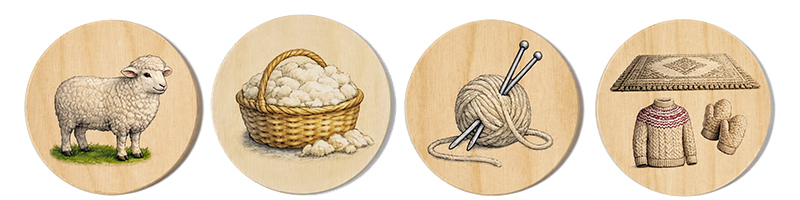
Sheep - Sheep's wool - Woolen yarn - Carpet, Sweater, Mittens
A sheep is a farm animal with thick, warm wool. The wool covers its body like a fluffy coat and helps the sheep stay warm. When the wool grows long, it is carefully cut off with special shears or a machine.
Sheep's wool. After shearing, the wool is first cleaned of grass, dust, and other small particles. Then it is washed, dried, and carefully combed so the fibers become soft, even, and fluffy. This prepares the wool for the next step — turning it into yarn.
Woolen yarn. The prepared wool is stretched and twisted into long woolen thread. Twisting makes the yarn strong.
Different warm things can be made from wool: a carpet, a sweater and mittens.
To make a carpet, woollen threads are tightly woven together or attached to a base. Sometimes patterns are made on the carpet using threads of different colours. The carpet becomes soft, thick and warm — it feels nice to walk on it barefoot.
To make a sweater, pieces are knitted from woollen yarn: the front, the back and the sleeves. Then these pieces are sewn together, and a collar and cuffs are added. A woollen sweater keeps you warm in cold weather.
To make mittens, woollen yarn is knitted into little loops in the shape of a hand. A mitten has a place for the thumb and one warm little house for the other fingers. That is why mittens keep hands warm even in winter.

Tree - Logs - Boards - Toilet Paper, Book, Wardrobe
A tree is a large plant with a strong trunk, branches and leaves or needles. The trunk of a tree is made of wood — a hard natural material. Trees grow for many years, so it is important to protect them and plant new ones.
Logs. When a tree is cut down, the trunk is cleared of branches, and logs are made. Logs are heavy and covered with bark. They are taken to a sawmill or a factory, where different materials are made from wood.
Boards. To make boards, a log is sawn into long, even pieces. Then the boards are dried, planed and sanded to make them smooth. Boards are useful for building, making furniture and creating different wooden objects.
Different things can be made from wood: toilet paper, a book and a wardrobe.
To make toilet paper, wood is chopped up and turned into a soft pulp. Very thin paper is made from this pulp, then it is dried and rolled into rolls. This paper becomes light and soft.
To make a book, sheets of paper are first made from wood pulp. Letters and pictures are printed on the sheets, then the pages are placed in the right order and joined together. That is how a book is made — a book you can read and look through.
To make a wardrobe, boards or wooden panels are used. They are cut into pieces of the right size: sides, doors and shelves. Then the pieces are sanded, joined together, handles are attached — and a wardrobe for clothes, books or toys is made.

Sugar Beet - Juice - Sugar - Sweet Bars, Lollipop, Caramel
Sugar beet is a plant with a large root. It grows in the ground, and green leaves grow above it. Inside the root there is sweet juice, which people have learned to turn into sugar.
Sweet Beet Juice. When the beets are harvested, they are taken to a factory, washed well and cut into thin pieces. Then these pieces are heated in water, and the sweet juice comes out of the beet. This juice is cleaned so that it becomes light-coloured and suitable for making sugar.
Sugar. The sweet juice is heated for a long time, and the extra water slowly evaporates. The juice becomes a thick syrup, and then tiny white sugar crystals appear in it. The sugar is dried — and it becomes loose, sweet and white.
Different sweets can be made from sugar: sherbet, a lollipop and caramel.
To make sherbet, sugar or sweet syrup is mixed with nuts, seeds, flakes or pieces of biscuit. Then the mixture is spread out in an even layer, left to harden and cut into rectangular pieces.
To make a lollipop, sugar is heated with water until it turns into a thick hot syrup. Then the syrup is poured into a mould, for example in the shape of a rooster, and a stick is inserted. When the syrup cools down, it becomes a hard, transparent lollipop.
To make caramel, sugar is heated more strongly, and it changes colour — it becomes golden and fragrant. The hot caramel is poured into moulds or cut into small pieces. When it cools down, sweet caramels are made.

Rubber Tree - Latex - Rubber - Tyre, Balloon, Rubber Boots
A rubber tree is a plant that gives a special sap. A careful cut is made in the bark of the tree, and a white liquid called latex begins to flow out. The tree is not cut down: the sap is collected carefully so the plant can keep growing.
Latex looks like white milk. It is collected in small cups and then taken to a factory. Rubber is made from latex — a soft and stretchy material that can stretch.
Rubber. To make rubber, natural rubber is mixed with other substances and heated. This makes the material stronger, more elastic and more useful for different things. Rubber can stretch, bend, keep water out and return to its shape.
Different objects can be made from rubber: a car tyre, a balloon and rubber boots.
To make a tyre, the rubber mixture is rolled out, shaped into a circle and strengthened with strong threads or metal wires. Then the tyre is heated in a special mould, and a pattern appears on it — this is called the tread. This tyre helps a car grip the road firmly.
To make a balloon, very thin and soft rubber is used. A mould is dipped into liquid latex, dried, and then the balloon is removed from the mould. The balloon is light and stretches when air is blown into it.
To make rubber boots, rubber is heated and shaped like a boot. Then the boots are cooled, checked and decorated with colour or patterns. Rubber does not let water through, so you can walk through puddles in these boots — and your feet will stay dry.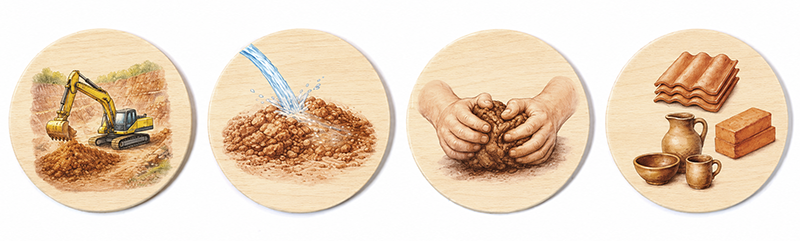
Clay - Wet Clay - Clay Mass - Roof Tiles, Dishes, Brick
Clay is a natural material found in the ground. It is dug from quarries with the help of big machines, such as excavators. At first, clay can be hard, dry and lumpy, a bit like soil or stones.
Wet Clay. To make clay easier to work with, water is added to it. The lumps become softer, and the clay becomes smoother and stickier. This kind of clay can already be kneaded, shaped and moulded.
Clay Mass. Wet clay is kneaded well by hand or with special machines. This helps make it smooth, soft and free of extra lumps. Such clay mass is easy to use for making dishes, bricks, roof tiles and other objects.
Different things can be made from clay: roof tiles, dishes and bricks.
To make roof tiles, clay is rolled out or placed into special moulds. It is shaped into a wavy form, dried and then fired in a hot kiln. After firing, the roof tile becomes hard and strong, and it helps protect a house from rain and snow.
To make dishes, clay is shaped by hand or turned on a potter’s wheel. This is how jugs, cups, bowls and plates are made. Then the dishes are dried and fired in a kiln so they become strong and can be used for a long time.
To make a brick, clay is placed into rectangular moulds. Then the bricks are dried and fired at a high temperature. After that, they become hard and strong and can be used to build houses, stoves and walls.

Sand - Molten Glass - Glass Sheets - Window, Glasses, Magnifying Glass
Sand is made up of many tiny hard particles. It can be found on the seashore, by a river or in a sandbox. To make glass, people use special clean sand that contains a substance which helps create a transparent material.
Molten Glass. To make glass, sand is mixed with other substances and heated very strongly in a large furnace. Because of the heat, the mixture melts and becomes thick, stretchy and hot, a bit like golden honey. Molten glass must be handled very carefully.
Glass Sheets. When molten glass is rolled out or poured into an even layer, glass sheets are made. Then the glass slowly cools down and becomes hard, smooth and transparent. These sheets can be cut into pieces of the right size.
Different objects can be made from glass: a window, glasses and a magnifying glass.
To make a window, a large glass sheet is cut to fit the window frame. Then the glass is placed into the frame and fixed in place. A window lets light into the room and helps protect the house from wind, rain and cold.
To make glasses, small pieces are cut out of glass. They are polished in a special way to make lenses that help a person see better. Then the lenses are placed into a frame — and that is how glasses are made.
To make a magnifying glass, a curved piece of glass is used — a lens that makes objects look bigger. This lens is carefully polished and placed into a handle or frame. If you look through a magnifying glass at a small letter, a leaf or an insect, they will seem larger.